Deutsch
 Français
 Italiano
 Español
 USD
USD GBP
GBP
TV Mount for Motorhomes:
The 4 Most Important Requirements
Are you planning to install a TV in your motorhome? Caution: Standard wall mounts are a safety risk. They cannot withstand the vibrations and centrifugal forces experienced while driving.
In this guide, you will learn:
- 🚫 Why normal TV mounts fail
- 🛡️ How to ensure driving stability
- 🪵 How to find the right wall surface
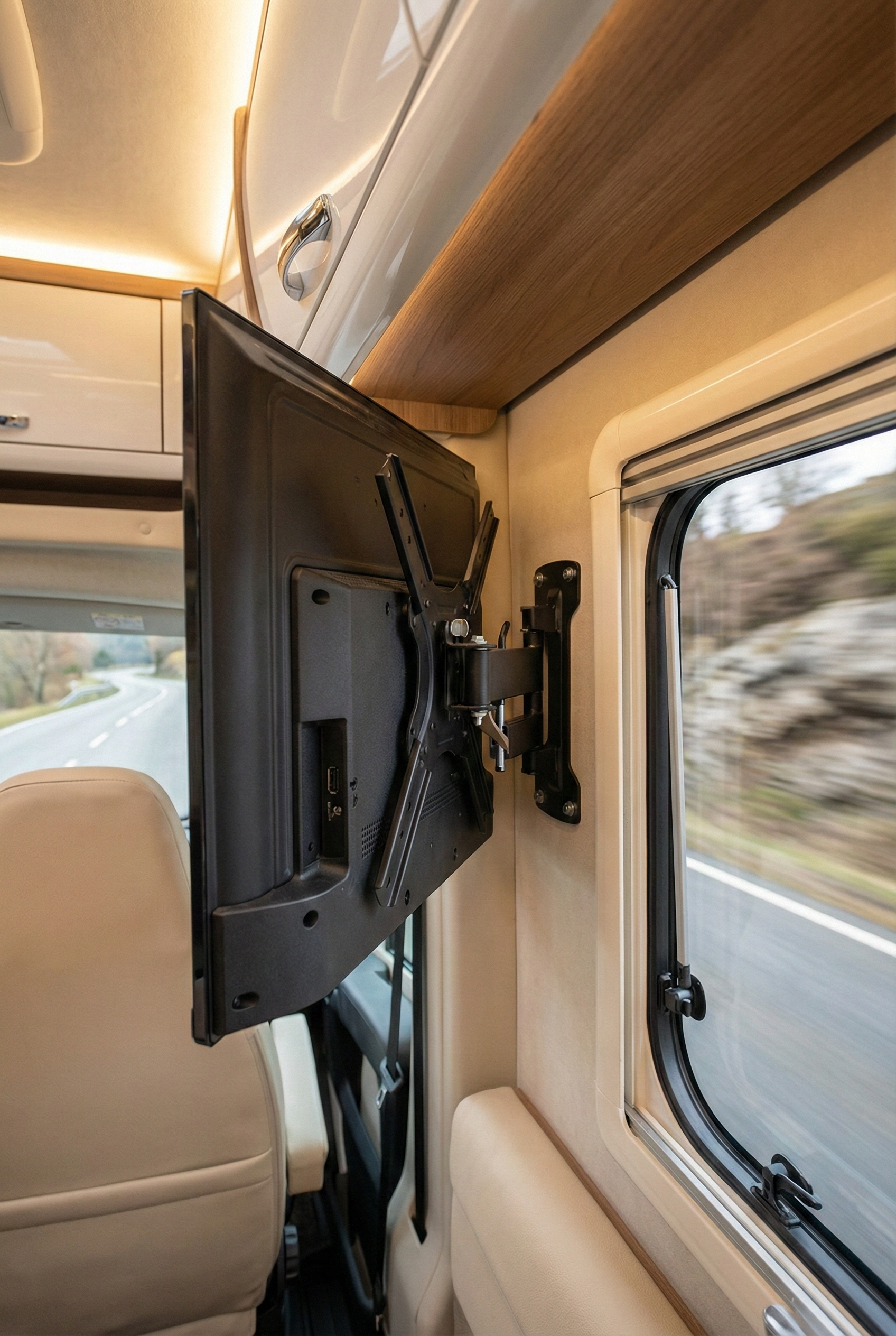
Table of Contents (Navigation)
1. Transport Safety: Protection While Driving
Why a locking mechanism is vital
The essential distinguishing feature from a home mount is the locking mechanism. In a stationary house, only vertical weight forces apply. In a vehicle, however, massive dynamic forces occur with every braking maneuver, every corner, and every pothole.
Without a mechanical safeguard, an articulated arm would swing out uncontrollably in curves. Due to leverage, even a light 5kg TV develops destructive force (kinetic energy) sufficient to break hinges, shatter the display, or rip the entire mount out of the lightweight wall.
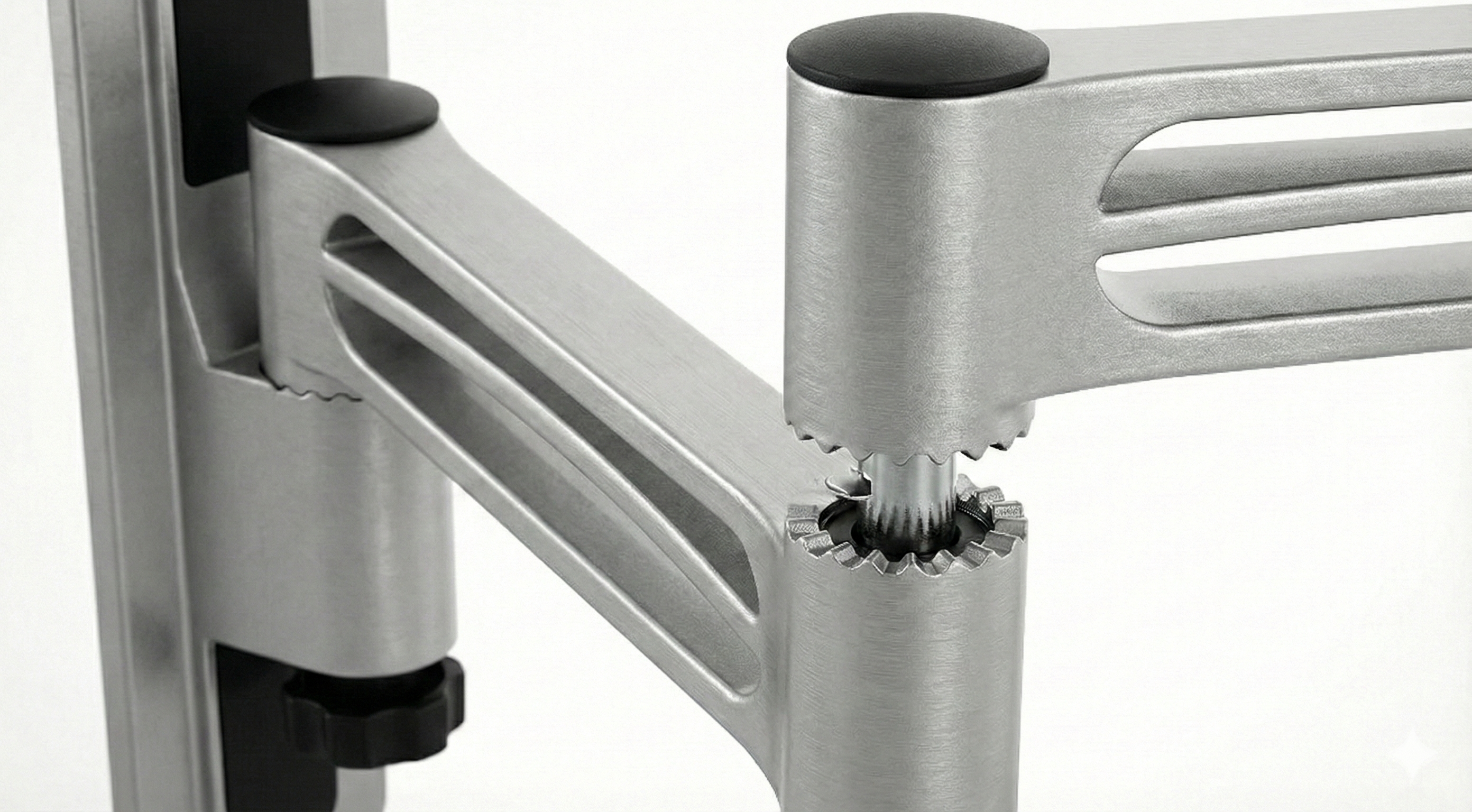
- Lock-Pin / Locking Bolt: The classic solution. A manual metal bolt is pushed through the folded arm, mechanically fixing it to the wall plate. Advantage: Very robust and affordable. Disadvantage: Must be operated manually.
- Click-System / Snap-Lock: The comfort solution (e.g., from Vogel's). The arm audibly clicks into the park position automatically when pushed back. A lever or pull cord must be used to release it. Advantage: Misuse is almost impossible.
- Rattle-Free / Anti-Vibration: Special plastic bearings or rubber buffers in the joints prevent metallic rattling while driving.
-%E2%80%93-verriegelbar--schwingungsgedaempft-(sicher-fernsehen-auf-reisen--schwenkbar--neigbar--arretierbar-%E2%80%93-fuer-bildschirme-bis-15-kg-%E2%80%93-20-jahre-garantie.)___328_0_752692.jpg)
2. Mounting Surface: Finding the Right Wall
Before purchasing, an analysis of the mounting surface is indispensable. Motorhomes (especially semi-integrated and alcove models) are not made of brick and concrete. The walls are optimized for lightweight construction, which complicates the mounting of heavy loads.
First, identify which surface you are dealing with:
(e.g., exterior side of a wardrobe). Usually 10-15mm solid plywood or coated chipboard.
Typical for exterior walls or bathroom walls. Structure: Thin aluminum/GRP skin outside, insulating core (Styrofoam/XPS) in the middle, thin decorative wood (3mm) inside.
How do you find out what is hidden behind the wallpaper? First, perform a knock test: A hollow, bright sound indicates unsuitable cavities. A dull, solid sound points to solid struts. Also, orient yourself by already mounted wall cabinets – load-bearing slats almost always run in the wall there. For absolute certainty, we recommend using a digital stud finder to locate the framework with millimeter precision.
3. Flexibility: Swivel Arm or Fixed Mounting?
The mounting position in a camper is often a compromise between available space and statics. This frequently leads to the TV not hanging optimally for the seating position. The right articulated arm construction compensates for this.
| Design Type | Primary Area of Use | Technical Evaluation |
|---|---|---|
| Fixed / Flat | Sleeping area (direct line of sight opposite) | + Maximum Stability - Static viewing angle (poor for LCDs) |
| 1 Articulated Arm | Seating group (Dinette) | + Tiltable & Swiveling - Limited reach |
| 2 Articulated Arms | Combined use (Bed & Seating group) | + Large radius ("Around the corner") - High leverage effect on the wall |
- Static viewing angle
- Limited reach
- High leverage effect
Important: The Tilt Function
In motorhomes, TVs are often mounted very high (e.g., above the refrigerator or entrance door) due to space constraints. If you look up from the bench seat, the image on LCD/LED TVs can appear dark or distorted in color. Therefore, ensure you choose a mount that can tilt downwards by at least 10-15 degrees (tilt angle) to enable a perpendicular viewing angle.
4. Compatibility: VESA Standard & Load Capacity
For a compatible installation, hole spacing (VESA) and weight must match exactly. Measure these values before purchasing your flat screen or the mount.
The Hole Pattern (VESA)
Determine the distance between the four threaded holes on the back of your device in millimeters (Horizontal x Vertical). You can find detailed help in our VESA Standard Guide.
- Small Camping TVs (19-24"): Usually 75x75 or 100x100.
- Smart TVs (from 32"): Frequently 200x100 or 200x200.
The Load Capacity (Weight)
In addition to the device weight, also consider the dynamic load caused by vehicle movements.
Choose a mount whose maximum load capacity exceeds the weight of the TV. A 5kg device on a mount designed for 15kg offers necessary reserves for vibrations.
📚 Deepen your knowledge: Understand the physics behind it. Our guide explains exactly how weight and leverage are related.
The 4 Most Important Points for a Safe Motorhome TV Mount
To ensure your TV installation in the motorhome is safe, you should check off these factors before buying:
vesa-adapter.de Expert Knowledge: Common Questions about TV Installation in Campers